This article is also available in Slovenian
Interview: Jaka Prijatelj
Jaka Prijatelj is the author of a book about Trubarjeva Street titled The Street. He is a photographer, antiquarian bookseller, and the long-time manager of the family business Carniola Antiqua, a dealer in antiques and artworks founded in 1989. In addition to running his business on Trubarjeva Street, Jaka documents the life of the street through his camera, takes part in and co-organises events, and, in a sense, breathes with the street itself. Although he does not work in the hospitality sector himself, he knows the people running Trubarjeva Street’s food and hospitality businesses very well—both the longest-established ones, who arrived on the street alongside him or even earlier, and the newer arrivals who are still finding their place. In this short conversation, he talks about where he likes to eat, who the residents of Trubarjeva Street are, who provides food there, why there is an “Indian quarter” on Trubarjeva Street measuring all of four square metres, and how the street’s longest-established hospitality businesses are run by Albanian owners.
When speaking about restaurant owners, Jaka frequently used national labels that, in another context, might sound stereotypical or even exclusionary. In the context of this conversation, however, they conveyed a sense of familiarity and closeness. Thus, Jaka mentions Albanians, Chinese, Americans, and Indians, but he is really speaking about friends, acquaintances, and customers. In anthropological interviews, such moments become particularly interesting when viewed in relation to the situation in which they were uttered. Yet when presented in a public format such as this one, they also raise a host of questions.
The text that follows is based on the conversation, has been reviewed and approved by the interviewee, and has in places been editorially adapted for this format. Some adjustments were also made in response to the dilemmas surrounding the use of national labels mentioned above. If you would like to learn more about the background of anthropological interviews, or about this particular conversation and the editorial interventions involved, please contact us at footnotes@zrc-sazu.si.
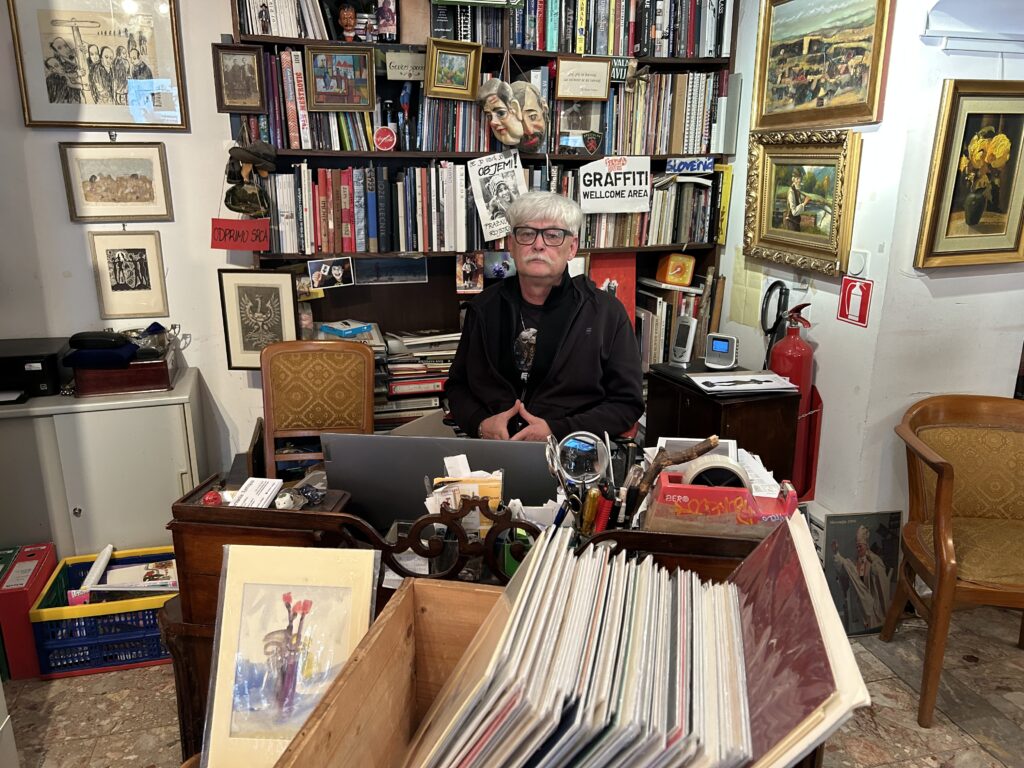
To start with a simple question: when did you come to Trubarjeva Street, and why did you choose this particular street?
In 1989. That’s when I registered the business. We opened the shop—it’s been so many years now that I sometimes get mixed up—we opened in February 1990. And I’ve been here ever since. I chose Trubarjeva for a very simple reason: there was an empty space available here. That was the only reason at the time. Things were quite different back then. The 1990s were different, and so was life under socialism before that. Then luck smiled on me. There was a textile shop here, and when they moved out, we jumped at the opportunity. At the time, the premises were still owned by the municipality. Then restitution happened, and the property changed hands, so it now has different owners. I just keep paying the rent.
Do you have any childhood memories connected to Trubarjeva Street?
As a child I used to come here with my father. He was a shoemaker, and there were many shops selling shoemaking materials here back then—the street has a leather-working tradition going back to the 19th century. We would come to buy materials. And then there was Meta, the neighbour who ran a hair salon. She was very chic, I used to go there for haircuts already in the 1980s. She was travelling to London even back then. I would say Trubarjeva wasn’t that lively in the 1980s. It really took off later, in the 1990s. That was the boom. Every empty space got filled. BTC [shopping centre in Ljubljana, ed. note] was still in its early phase, so everyone was pushing towards the city centre. Then, around 2000, those shops started closing down, and food places began opening instead. And Trubarjeva Street slowly turned into a kind of multicultural culinary hub of Ljubljana.
I also used to walk along Trubarjeva a lot as a child. I lived not far away, and almost every day I would walk down the street to music school. From my childhood in the late 1980s, I mostly remember only the lower part of Trubarjeva, from Resljeva Street to the Prešeren Monument, where I passed daily—on my way to music school or with my mother to Centromerkur to buy buttons and zips. I also had a friend who lived on Trubarjeva, somewhere behind your antique shop there’s a passageway—she lived there. I remember that for children at the time, the city centre wasn’t really a paradise; there weren’t many places where we could actually play.
I know the passage you mean. Next to it there used to be a restaurant, where Dalmacija was, and also the first Japanese place, run with help from Takashi. He was one of the first Japanese people to have a Chinese restaurant here [on Trubarjeva Street, ed. note]. At Trubarjeva 50 there is now also a Chinese restaurant, but he was the first. Where Njam Njam is now, Takashi already opened a Chinese place in the 1990s.
You came in the 1990s, as you said, more because of the opportunity that appeared at the time. Do you feel today that you are part of Trubarjeva? When we started the research, friends and acquaintances suggested we should talk to you, and we had the impression that you are considered almost a legend of the street.
Of course, I feel part of this street. That’s almost automatic, I think. I’ve been here so long that Trubarjeva has become part of me. If you stay somewhere long enough, if you spend enough time in a place, you simply become part of it—maybe even a kind of legend. At some point I’ll have to retire, but then I’ll probably just get bored.
Who would you call the legends of Trubarjeva’s food scene?
The ones who have been working continuously since the Yugoslav period—since the 1960s and 1970s, mostly Albanians. The same families have owned these spaces ever since. One example is Reformator, and a bar named Trubar a bit further down has a similar story. Then there is also Adria, right by Resljeva Street, which is known for ćevapi [a traditional Balkan dish made of seasoned minced meat shaped into small sausages and grilled, ed. note] but also works as a pastry shop. I think Albanians are among the longest-established people running places to eat here. I used to go there for cream cakes when I was getting my hair cut at Meta’s in the 1980s.
Today you say Trubarjeva Street has a multicultural character, but you mentioned that when you first arrived it wasn’t like that.
Yes, Trubarjeva slowly became multicultural over time. In Yugoslav times it was more of a transitional street—people would just pass through it, walking from the city centre to the medical centre and back, or, as you said, to music school. Apart from the Albanian-run places, there was hardly anything else here. On the other side there was Bobenček, where skinheads used to hang out until they got beaten up. People would beat them up and then things would calm down. They wanted to celebrate Hitler’s birthday and they set off from Bobenček with banners, but by Tromostovje people were already waiting for them, and then the police chased them up to the castle. After that it was quiet. Do you remember when skinheads once attacked Janez Belina on Trubarjeva Street? He came here during the Non-Aligned Movement period [from Guinea-Bissau, ed. note], he was studying forestry here. Janez Belina is his artistic name; he also appeared on television. All sorts of things happened. After all, even the well-known Slovene actor Gašper Tič was killed here on Trubarjeva. It’s a long street—many different things have happened here.
Would you say it’s a long street?
Yes, a lot happens here. On the other side, towards the Medical Centre, there used to be a kind of cult place called Bar Trenutek [trenutek means moment, ed. note]. It stood right at the very end of Trubarjeva, where the bakery is now. I even have a photograph of it in my book. People from all sorts of backgrounds would meet there, they even had cigarette ads written in Arabic. People from the nearby housing blocks would also go there, because Refič [short for Reformator bar, ed. note] was more of a place for television and radio people.
Television people used to go to that Bar Afrika as well, right?
Yes, because it was close. They even covered the windows so you couldn’t see what was going on inside, what people were drinking in the morning.
What about the differences between the two parts of the street? Do you feel it works as a single street, or are there two or even more Trubarjeva Streets? You mentioned an upper and a lower part of the street.
Meta the hairdresser would know more about that. In the old days there was even some tension. People used to divide it into the “bourgeois” part—from Resljeva Street to Prešeren Square—and the other side, I’m not even sure what they called it, something more “village-like,” as if it was worth less. But from the city authorities’ side, it was a rather neglected street for a long time. We only got New Year’s lights a few years ago. The so-called bourgeois part was always the livelier one.
You said that the part of Trubarjeva between Resljeva and the Prešeren Monument feels more lively to you, but I actually have the opposite impression.
That’s because of food. Today it’s restaurant next to restaurant, and people just come here to eat. I do the same myself—one time here, another time there. There’s so much choice that you can eat food from all over the world right here on Trubarjeva.
What would you say makes Trubarjeva different from other streets in Ljubljana?
Trubarjeva has a soul. The people who used to walk here, meet here, live and work here, they all expressed a sense of belonging to the street—unlike, say, Mestni trg. But those were mostly older people, almost none of them are left now. Meta is still there. Before, everything was full of life, people actually lived here. Now it’s mostly tourist apartments—that’s a big difference. In the 1990s children were running around here, you wouldn’t see a child here now. It’s simply not really a place where you can live easily.
Because there’s no car access?
Yes, no access, no parking, no shops. For a family it’s quite exhausting—you have to park far away. Everyone who had the chance moved out. It’s also a problem for older people.
Do you feel that Trubarjeva still has a soul, despite all these changes?
Yes, of course—it’s still there. As we wrote in the book, that soul, unlike in the past, now lives during the day. Trubarjeva is a daytime street; when the shutters go up, life starts. You don’t even really notice who is missing up above, in the apartments. So, during the day it’s full of life. Tourists have also discovered it now, and they come here in large numbers. That’s why new places are opening up again. For example, Mauro from Italy opened a family-run osteria right next to me.
Before we get even more into food, I have one more question. Earlier in our conversation we talked about where Trubarjeva actually is—or what counts as Trubarjeva. Is it just the main street, or do all these side streets belong to it as well? When you describe Trubarjeva, you often seem to turn left, right, up and down…
Trubarjeva is this artery that runs from the Medical Centre to Prešeren Square. But, how should I put it—physically and also in a kind of spiritual sense, those little streets also belong to Trubarjeva: Prečna Street, the little side passages, all of that is part of it. I even consider the Dragon Bridge part of Trubarjeva, for a simple reason: when you walk down the street, you see it right in front of you. Prešeren Square as well—it’s where Trubarjeva Street begins. It starts at Prešeren Square and ends at the Medical Centre. And down there, near the church of St Peter—actually behind the church—that’s where it ends. That is the oldest parish here, and there used to be a cemetery. They even found skeletons there; there was probably a Roman road here too. In that park they found a Roman coin. This was a kind of suburban road running along the river. So, I think it’s two thousand years old—not as a street, but as a road.
And what about today—the part along the river? Is that still considered an expanded Trubarjeva Street?
Of course. Most of the buildings on Trubarjeva actually also face the Ljubljanica River. These days it’s very tourist-heavy along the river, but here and there you still find a story that belongs to Trubarjeva as well. For a long time, there was nothing on the riverbank. Only Čarli. That was where journalists and photographers used to gather. Čarli also belongs to Trubarjeva—it was apopular local institution, with a regular crowd. Journalists from Dnevnik[a Slovene daily newspaper, ed. note] used to go there. Now there’s the restaurant Most.
If we go back to food again—you said that food starts appearing on Trubarjeva in the 1990s.
Yes, after 2000, and especially in the last ten years, there has been an invasion of these places. The difference is that before it was mostly locals gathering here. Now there are many tourists. In the past, you kind of knew where to find your regular “coffee people” across Ljubljana—they had their spots. Now everything is mixed together. In a way, this multicultural cuisine started with tourism and migration. People then opened all these different kitchens—African, Asian, and who knows what else. Everything is there now. Falafel is Arabic, I know the owner.
Are you more in contact with migration if you work and live on Trubarjeva Street?
I feel migrants have other problems—they’re not really visible here. It’s mostly tourists from all over the world who come in. Like the Chinese. I actually like the Chinese, because they always buy something. They turn the shop upside down like kids, they get into arguments, they leave offended, and then five minutes later they come back, throw down the money and take something. Americans are a different story. Every two minutes they ask you how you are, how things are going, and then God forbid you say you’re not doing well, because then their whole world falls apart. They’re almost a bit too sweet.
So, you mostly experience migration through tourists?
Yes, I have more contact with tourists. Migrants have other problems. They just pass by, that’s what I see. I’ve never had any problems with anyone. I’ve had problems with drugged-up Slovenians, though. Those are the ones I’ve had issues with. The other day one of them pulled a knife on me. He was on cocaine, full of himself. Junkies are dangerous because you never know how they’ll react. With migrants, I have the feeling they come in through the food being offered. A lot of migrants now work in kitchens on Trubarjeva. Not just from Africa, from everywhere—Afghanistan, India, I don’t know… It’s already standard now. I think things changed after COVID. A lot of people were laid off, and then they found other jobs and don’t want to work in restaurants and tourism anymore.
Is there a difference between older and newer food places on Trubarjeva?
A lot of the older ones are gone. Trubar [Trubar, a bar named after the street — ed. note]is the oldest place here and Albanian owners from the Yugoslav period were the first. They have burek and doughnuts, the best in Ljubljana, and there are often queues for their doughnuts. It’s already a kind of tradition here that the best doughnuts in the city are on this street. The newer food places have mostly arrived in the last ten years. Maybe Čompa has been here longer, and Abi Falafel has also been around for quite some time—I think about 30 years. The owner is Abder Shaar, I know him, he’s Palestinian. They’re doing well, and they keep their quality.
Is there any kind of social life among the people on Trubarjeva? I’m not sure how to put it—among you here, even though you’re not really residents.
Yes, we are residents in a way, even if we don’t sleep here. In fact, we are the last residents of Trubarjeva—the people who work in bars, restaurants and shops. Here and there someone still lives here, but very few. In the past there was much more of this social life. In the 1990s we even had football tournaments, all sorts of things. We also had an Oscar de la Renta party, when we got a box of glasses from that New York designer. We set up skate ramps too, but mostly the owners or tenants of the places did that. Refič and Nostalgija… those two were very connected, they organised competitions. We had photo exhibitions, concerts, street picnics, graffiti exhibitions—we had the biggest graffiti, you could see it from an airplane. That kind of social life doesn’t really exist anymore. Every now and then they roast a pig over there, on the other side from Refič. Reformator or Refič is the most active when it comes to events. We call the owner Bule. A few years ago, they even tried to organise an alternative food fair here, but it didn’t really take off. We also once had an auction in the middle of the street. That was on Trubarjeva Street Day.
This year I went to Trubarjeva Street Day. I spoke with a woman from the Bosnian association Ljiljan, who had a stall there. She also lives on Trubarjeva, but in the upper part, as you would call it.
Yes, all sorts of things happen. If you look at it that way, that upper part tends to organise things more on its own. They also had that project, Trubarjeva na dlani [a project entitled Trubarjeva Street at Your Fingertips, ed. note]. In that project, there isn’t really anyone from the lower part involved, except me. I work with everyone. I think this is also connected to the fact that these places change owners so often. The owners have other problems—they don’t have time, they need to survive. You can afford these kinds of activities only if your business is doing reasonably well.
I heard that this year Rog was also involved in organising Trubarjeva Street Day?
I wasn’t there this year I don’t know. I think there are two different Rogs. The people who used to be there were completely different, and in the new situation they haven’t really managed to come together [Rog is a former bicycle factory and long-time autonomous cultural centre, recently renovated and reopened by the municipality after a contested redevelopment process, ed. note].
Was the old Rog more part of Trubarjeva than the new one?
In my opinion both are part of Trubarjeva, but the new one is still fighting for its place. It still feels a bit empty. The old Rog was full of creativity, colour, energy. I used to go there to take photos and for exhibitions. The new Rog feels a bit sterile to me. Even the restaurant there is a bit fancy. People do go, but they still need time to get used to it, to build up a regular crowd—like Cukrarna [a former sugar refinery, now a contemporary art exhibition venue, ed. note].
Is Cukrarna still part of Trubar Street, or is that already another story?
If you look at Juš Kozak, the modernist writer—he wrote a novel called Šentpeter [St. Peter, a historic district of Ljubljana, ed. note]—he saw all of this as part of the Šentpeter suburb. For them, it was all basically a suburban area. I see the difference more in terms of time: it used to be a suburb of Ljubljana, today it’s a street.
Where do you go for coffee or lunch?
If I want to sit down, I go to Refič. But new places are opening everywhere. There used to be this tiny café next door, just a small window service. There are different periods. When I get bored, I go somewhere else—I don’t go far. After lunch I might go for coffee. The only problem is there’s so much choice. By eleven I’m already thinking about food—pleasant worries, right? I like curry, I sometimes go for carbonara in the back, or to the other Italian place for pasta. I also like going to Abi for falafel, and sometimes to Baščaršija for ćevapi. Everything has become quite expensive though. But the fanciest place on Trubarjeva Street at the moment is TaBar in Rog centre.
How familiar are you with the Asian food offer on Trubar Street?
The Korean place just closed down. They were selling dumplings. Then there’s that Chinese place next to the ćevapi shop. There’s also an Indian one nearby. And then there’s that shop, Svilna pot [Silk Road, ed. note], selling Asian goods. A bit further down, near Čompa [a regional Slovene word for potato, ed. note], there’s a Thai place—but I don’t eat there. You have to eat standing outside, and the prices are high. And then you’re standing there in the snow on one leg, paying a lot for it.
Would you say Asian food is already part of Trubar Street?
The Korean place is gone anyway. I know the owner of the Chinese place—he used to run Kitajski vrt [Chinese Garden, ed. note] in Dravlje. It takes time in one place before you really become part of it. Before that there was another Chinese place, and before that Takashi. He was at Trubarjeva 50. He would also know a lot, including about the Japanese restaurant that used to be behind here. And there are three Indian restaurants. I go to the first one—the owner is someone I know, she’s an Indian-Slovenian woman. Just a few days ago a new Chinese restaurant opened behind us.
It smells a lot like curry around there…
I’d say there’s an Indian quarter there, about four square metres in size. There’s that restaurant, and across the street the shop selling incense sticks. Indian people eat there too. I think it’s actually a sign of quality if they eat there. I often see Indian people there, although I think many of them work in the kitchens nearby. They prefer their own food—it’s more heavily spiced.
We had some Indian researchers visiting a few years ago. When we took them to our restaurants, they said the food was too meat-heavy. In the end, they also went to an Indian restaurant.
But even in Slovenia, a hundred years ago we didn’t eat that much meat. It was more for holidays; otherwise meat was just an addition—like crackling and lard for flavour. This heavy meat industry has really only developed in the last fifty years, and I find it quite disgusting.
How did your book come about?
I’ve been taking photos my whole life, walking around and photographing. The book contains about fifteen years of photos of Trubarjeva Street—around 500 images. Publishers approached me with the idea of making a photography book, but nothing came of it in the end. So, I ended up making and publishing the book myself, and I managed to sell it out.
You can really feel the love for the street in the book…
Yes, of course. I also write stories sometimes. One fairy tale will be published by Mladinska knjiga [a major Slovene publishing house, ed. note], about Brane the pigeon from Trubarjeva. I don’t think the city treats pigeons well, even though they’ve always been part of Trubarjeva. Those spikes and all that crap they put up for them… I recently found one dead, stuck on the spikes [on the façade above a window, ed. note]. It had been dying for three days.
Published June 2026. 2026/3